Na primeira parte, Desenvolvimento de uma máquina virtual empilhada e um compilador para ela (parte I), fiz minha própria máquina virtual de pilha elementar que pode trabalhar com a pilha, fazer aritmética com inteiros assinados, saltos condicionais e chamadas de função com retorno. Mas como o objetivo era criar não apenas uma máquina virtual, mas também um compilador C para essa linguagem, era hora de dar os primeiros passos em direção à compilação. Sem experiência. Vou agir de acordo com o meu entendimento.
"C " (, - ). - "" ( ) , .
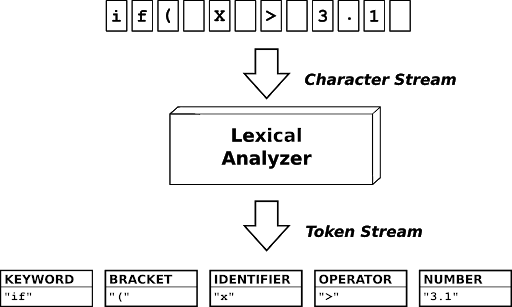
, - , , (, , , ). C.
constexpr char* BLANKS = "\x20\n\t";
constexpr char* DELIMETERS = ",;{}[]()=><+-*/&|~^!.";
enum class TokenType {
NONE = 0, UNKNOWN, IDENTIFIER,
CONST_CHAR, CONST_INTEGER, CONST_REAL, CONST_STRING,
COMMA, MEMBER_ACCESS, EOS,
OP_BRACES, CL_BRACES, OP_BRACKETS, CL_BRACKETS, OP_PARENTHESES, CL_PARENTHESES,
BYTE, SHORT, INT, LONG, CHAR, FLOAT, DOUBLE, STRING, IF, ELSE, WHILE, RETURN,
ASSIGN, EQUAL, NOT_EQUAL, GREATER, GR_EQUAL, LESS, LS_EQUAL,
PLUS, MINUS, MULTIPLY, DIVIDE, AND, OR, XOR, NOT, SHL, SHR,
LOGIC_AND, LOGIC_OR, LOGIC_NOT
};
typedef struct {
TokenType type;
char* text;
WORD length;
WORD row;
WORD col;
} Token;
, parseToTokens(char*). : (BLANKS DELIMETERS), , () . - , (, "315.0") / ("obj10.field1"), .
void VMLexer::parseToTokens(const char* sourceCode) {
TokenType isNumber = TokenType::UNKNOWN;
bool insideString = false; // inside string flag
bool isReal = false; // is real number flag
size_t length; // token length variable
char nextChar; // next char variable
bool blank, delimeter; // blank & delimeter char flags
tokens->clear(); // clear tokens vector
rowCounter = 1; // reset current row counter
rowPointer = (char*)sourceCode; // set current row pointer to beginning
char* cursor = (char*)sourceCode; // set cursor to source beginning
char* start = cursor; // start new token from cursor
char value = *cursor; // read first char from cursor
while (value != NULL) { // while not end of string
blank = isBlank(value); // is blank char found?
delimeter = isDelimeter(value); // is delimeter found?
length = cursor - start; // measure token length
// Diffirentiate real numbers from member access operator '.'
isNumber = identifyNumber(start, length - 1); // Try to get integer part of real number
isReal = (value=='.' && isNumber==TokenType::CONST_INTEGER); // Is current token is real number
if ((blank || delimeter) && !insideString && !isReal) { // if there is token separator
if (length > 0) pushToken(start, length); // if length > 0 push token to vector
if (value == '\n') { // if '\n' found
rowCounter++; // increment row counter
rowPointer = cursor + 1; // set row beginning pointer
}
nextChar = *(cursor + 1); // get next char after cursor
if (!blank && isDelimeter(nextChar)) { // if next char is also delimeter
if (pushToken(cursor, 2) == TokenType::UNKNOWN) // try to push double char delimeter token
pushToken(cursor, 1); // if not pushed - its single char delimeter
else cursor++; // if double delimeter, increment cursor
} else pushToken(cursor, 1); // else push single char delimeter
start = cursor + 1; // calculate next token start pointer
}
else if (value == '"') insideString = !insideString; // if '"' char - flip insideString flag
else if (insideString && value == '\n') { // if '\n' found inside string
// TODO warn about parsing error
}
cursor++; // increment cursor pointer
value = *cursor; // read next char
}
length = cursor - start; // if there is a last token
if (length > 0) pushToken(start, length); // push last token to vector
}
parseToTokens, , . .
class VMLexer {
public:
VMLexer();
~VMLexer();
void parseToTokens(const char* sourceCode);
Token getToken(size_t index);
size_t getTokenCount();
WORD tokenToInt(Token& tkn);
private:
vector<Token>* tokens;
WORD rowCounter;
char* rowPointer;
bool isBlank(char value);
bool isDelimeter(char value);
TokenType pushToken(char* text, size_t length);
TokenType getTokenType(char* text, size_t length);
TokenType identifyNumber(char* text, size_t length);
TokenType identifyKeyword(char* text, size_t length);
};
VMLexer C ( , ):
int main()
{
printf ("Wow!");
float a = 365.0 * 10 - 10.0 / 2 + 3;
while (1 != 2) {
abc.v1 = 'x';
}
if (a >= b) return a && b; else a || b;
};
:
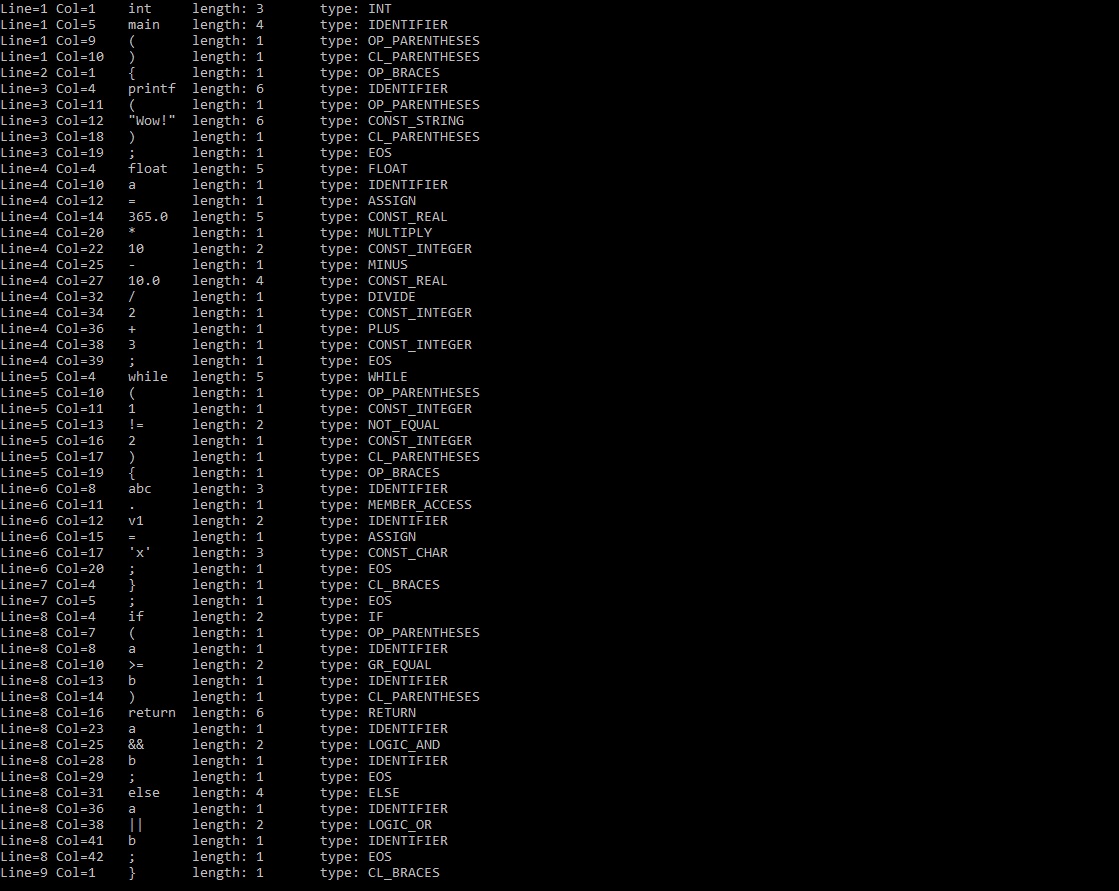
, . - . , :

. ( ) :
void VMCompiler::parseExpression() {
Token tkn;
parseTerm();
tkn = lexer->getToken(currentToken);
while (tkn.type==TokenType::PLUS || tkn.type==TokenType::MINUS) {
currentToken++;
parseTerm();
if (tkn.type == TokenType::PLUS) {
destImage->emit(OP_ADD);
} else {
destImage->emit(OP_SUB);
}
tkn = lexer->getToken(currentToken);
}
}
void VMCompiler::parseTerm() {
Token tkn;
parseFactor();
currentToken++;
tkn = lexer->getToken(currentToken);
while (tkn.type == TokenType::MULTIPLY || tkn.type == TokenType::DIVIDE) {
currentToken++;
parseFactor();
if (tkn.type == TokenType::MULTIPLY) {
destImage->emit(OP_MUL);
} else {
destImage->emit(OP_DIV);
}
currentToken++;
tkn = lexer->getToken(currentToken);
}
}
void VMCompiler::parseFactor() {
Token tkn = lexer->getToken(currentToken);
bool unaryMinus = false;
if (tkn.type == TokenType::MINUS) {
currentToken++;
tkn = lexer->getToken(currentToken);
unaryMinus = true;
}
if (unaryMinus) destImage->emit(OP_CONST, 0);
if (tkn.type == TokenType::OP_PARENTHESES) {
currentToken++;
parseExpression();
} else if (tkn.type == TokenType::CONST_INTEGER) {
destImage->emit(OP_CONST, lexer->tokenToInt(tkn));
}
if (unaryMinus) destImage->emit(OP_SUB);
}
Vamos tentar passar a expressão " -3 + 5 * (6 + 2) * 3 + 15/5" para o compilador , desmontar o código gerado no console e executá-lo imediatamente na máquina virtual. Esperamos que o resultado do cálculo permaneça no topo da pilha - 120 .

Viva! Ocorrido! Temos uma máquina virtual simples, mas funcional, lexer, compilador de expressões inteiras com constantes. Tudo isso é muito encorajador!
PS Claro, seria correto construir um AST completo (árvore de sintaxe abstrata), uma tabela de símbolos e muito mais para geração de código conveniente, que aprendi com os comentários, mas os primeiros passos para o compilador já foram ocupado.