Como converter texto em álgebra: exemplos

No artigo anterior , a representação de sequências de sinais por polinômios de unidades matriciais foi desenvolvida usando o exemplo de um texto linguístico. O texto se transforma em um objeto algébrico. Com o texto, você pode realizar todas as operações algébricas necessárias para a estruturação - cálculos de títulos, dicionários, anotações, marcação semântica. Este artigo fornece dois exemplos de estruturação algébrica de textos de natureza diferente. O código Morse foi escolhido devido à extrema brevidade do dicionário e às fórmulas matemáticas como um exemplo de problema inverso.


1. Código Morse-Weil-Gerke como uma álgebra de unidades matriciais

No código Morse, as sequências de símbolos (textos) de 26 letras latinas consistem em pontos e travessões. O exemplo foi escolhido devido à extrema brevidade do dicionário ("ponto" e "traço").


As palavras aqui são pontos ou travessões. 26 letras do alfabeto - textos de tais palavras. Cada palavra possui duas coordenadas. A primeira coordenada é o número da palavra (ponto ou traço) nesta letra (de um a quatro). A segunda coordenada é o número do dicionário (1 ou 2). Dicionário E 11 ("ponto") e E 22 ("traço").


D_R = E_ {11} + E_ {22}
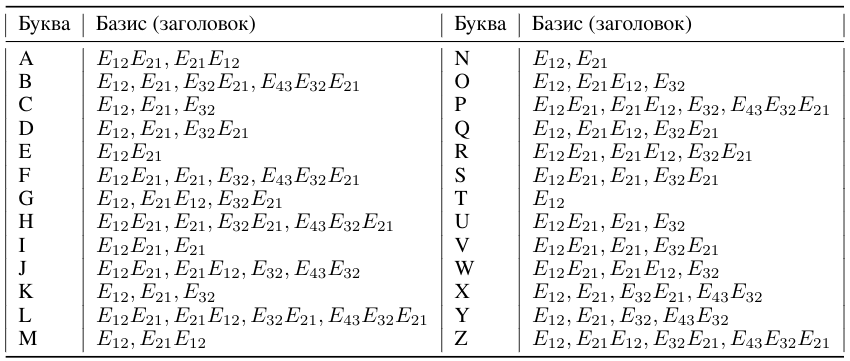
Tabela 1. Código Morse: Letras latinas como sequências de sinais (textos)

Cada letra (sequência de sinais) com um número da Tabela 1 pode ser associada a um polinômio de matriz P de 4x4 unidades de matriz de acordo com a fórmula (8) do artigo [1] .
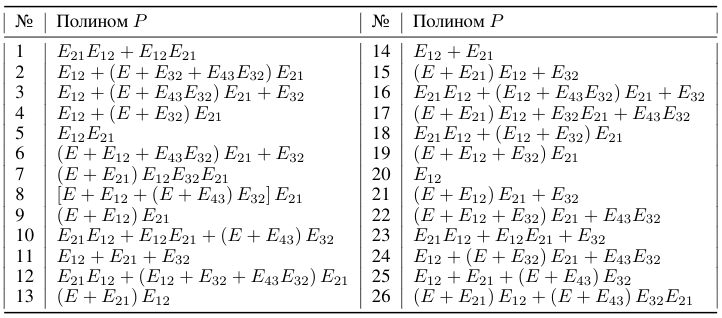


Tabela 2: Código Morse: letras como polinômios da matriz

Por exemplo, a letra Q (No. 17) está associada a um polinômio de matriz:
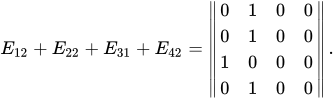


E_{12}+E_{22}+E_{31}+E_{42}= \begin{Vmatrix} 0 & 1 & 0 & 0\\ 0 & 1 & 0 & 0\\ 1 & 0 & 0 & 0\\ 0 & 1 & 0 & 0 \end{Vmatrix}.

26 - 2 ,   E12, E21, E32


26 2 ||P||, , :



  \begin{Vmatrix}         a_{11} & \ldots & a_{1n}\\         \ldots & \ldots & \ldots\\         a_{m1} & \ldots & a_{mn}     \end{Vmatrix}      \begin{Vmatrix}         b_{1} \\         \ldots \\         b_{n}      \end{Vmatrix}=     \begin{Vmatrix}         a_{11} \\         \ldots \\         a_{m1}      \end{Vmatrix}b_1+\ldots +     \begin{Vmatrix}         a_{1n} \\         \ldots \\         a_{mn}      \end{Vmatrix}b_n,

2 ||P||1, ||P||2, ||P||3.


    \left\|P\right\|=\left\|P\right\|_1\left\|P\right\|_1=\left\|P\right\|_2\left\|P\right\|_2=\left\|P\right\|_3\left\|P\right\|_3,


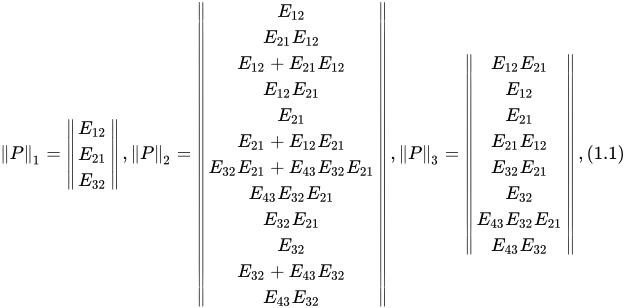
\left\|P\right\|_1=\begin{Vmatrix}         E_{12} \\         E_{21} \\         E_{32}     \end{Vmatrix},     \left\|P\right\|_2=\begin{Vmatrix}         E_{12} \\         E_{21}E_{12} \\         E_{12}+E_{21}E_{12} \\         E_{12}E_{21} \\         E_{21} \\         E_{21}+E_{12}E_{21} \\         E_{32} E_{21} + E_{43}E_{32} E_{21} \\         E_{43}E_{32} E_{21} \\         E_{32} E_{21} \\         E_{32} \\         E_{32} + E_{43}E_{32} \\         E_{43}E_{32}     \end{Vmatrix}, \left\|P\right\|_3=\begin{Vmatrix}         E_{12}E_{21} \\         E_{12} \\         E_{21} \\         E_{21}E_{12} \\         E_{32}E_{21} \\         E_{32} \\         E_{43}E_{32} E_{21} \\         E_{43}E_{32}     \end{Vmatrix},  (1.1)

||P||2(||P||2)T - - – ( ), , – () - .


(||P||2)T ||P||2 - - – , , – – () .


() (1.3). (1.3). 3 4:


 3:
3:
 4:
4:

: ABCDEFGHIJKLMNOPQRSTUVWXYZ


- ( -  E12, E21, E32) ( ) E12, E21, E32:


E12 - , «» 4- :


_BCD__G___K_MNO_Q__T___XYZ (13 )


E21 - , «» 4- :


_BCD_F_HI_K__N____S_UV_XY_    (13 )


E32 -  , «» 4- :


__C__F___JK ___OP____U_W_Y_ (9)


2.

[1] ( ), . – () ( ), , , .   .


VK, V  V:


 V_K=\frac{1}{3}\pi R_1^2H_1, V_{\text{}}=\pi R_2^2H_2, V_T=\pi^2\left(R_3+R_4\right)r,\ \ \ \ \ \ \ \ \         (2.1)

. , . , R12  –  R1R1, πR1 – , . (1): R1  H1  – , R2  H2 – , R3 – , R4 – , r – , ππ.


. . (2.1) , π.  R1, R2, R3, R4, H1, H2 r – . , , ( ), – : R1=ar, R2=br, R3=cr, R4=dr, H1=er, H2=fr . (2.1):
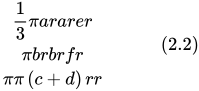


\begin{gathered}      \frac{1}{3}\pi ararer \\      \pi brbrfr \\      \pi \pi \left(c+d \right)rr \end{gathered} \ \ \ \ \ \ \ \ \ \ \ \ (2.2)

:


\begin{gathered}         \left(\frac{1}{3}\right)_{1,1}(\pi)_{2,2}(a)_{3,3} (r)_{4,4} (a)_{5,3} (r)_{6,4} (e)_{7,7} (r)_{8,4} \\         (\pi)_{9,2} (b)_{10,10} (r)_{11,4} (b)_{12,10} (r)_{13,4} (f)_{14,14} (r)_{15,4} \\          (\pi)_{16,2} (\pi)_{17,2} \left(c+d \right)_{18,18} (r)_{19,4}(r)_{20,4}      \end{gathered} \ \ \ \ \ \ \ \ \ (2.3)

(2.2)


 P=F_1(P)+F_2(P)+F_3(P), \ \ \ \ \ \ \ \ \ \ (2.4)

:


\begin{gathered}          F_1(P) = D_L\left(E_{1,1}+E_{2,2}+E_{3,3}+E_{4,4}+E_{5,3}+E_{6,4}+E_{7,7}+E_{8,4}\right)D_R \\ F_2(P) = D_L\left(E_{9,2}+E_{10,10}+E_{11,4}+E_{12,10}+E_{13,4}+E_{14,14}+E_{15,4}\right) D_R \\ F_3(P) = D_L\left(E_{16,2}+E_{17,2}+E_{18,18}+E_{19,4}+E_{20,4}\right) D_R \\ D_R = E_{1,1}+E_{2,2}+E_{3,3}+E_{4,4}+E_{7,7}+E_{10,10}+E_{14,14}+E_{18,18} \\ D_L = E_{1,1}+E_{2,2}+E_{3,3}+E_{4,4}+E_{5,5}+E_{6,6}+E_{7,7}+ \ldots + E_{20,20} = E \\ D_L=D_R+E_{5,5}+E_{6,6}+E_{5,5}+E_{8,8}+E_{5,5}+E_{9,9}       \end{gathered}

- :


P (2.1) . , , . , «1/3» ( E1,1), «a» ( E3,3+E5,3) , «e» ( E7,7) ( (2.5)). ( (2.5)) «b» ( E11,11+E13,11) «f» ( E15,15). ( (2.5)) (c+d) ( E20,20). , (2.5). :
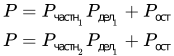


\begin{gathered}      P = P_{\text{}_1}P_{\text{}_1}+P_{\text{}} \\      P = P_{\text{}_2}P_{\text{}_1}+P_{\text{}}       \end{gathered}

:


     \begin{gathered} P_{\text{}_1} = \left(E_{2,18}+E_{4,12}+E_{6,14}+E_{8,16}\right) +\left(E_{10,18}+E_{12,12}+E_{14,4}+E_{16,16}\right)+\\ +\left(E_{18,18}+E_{19,19}+E_{21,12}+E_{22,14}\right), \\ P_{\text{}_2} = (E_{2,2}+E_{4,4}+E_{6,4}+E_{8,4})+(E_{10,2}+E_{12,4}+E_{14,4}+E_{16,4})+ \\ +(E_{18,2}+E_{19,2}+E_{21,4}+E_{22,4}), \\ P_{\text{}_1} = E_{18,2} + E_{19,2}+E_{12,4} + E_{14,4} + E_{16,4}, \\ P_{\text{}_2} = E_{2,2} + E_{4,4}, \\ P_{\text{}} = E_{1,1}+E_{3,3} + E_{5,3}+E_{7,7}+E_{11,11} + E_{13,11}+E_{15,15}+E_{20,20}.\\     \end{gathered}

(2.6) P1 P2. P1 (2.1). P2 DR (2.1). , (, – , , , ). , , π r2, r2 π.


- (2.6):


     \begin{gathered} P_{\text{}_1}+P_{\text{}} \\ P_{\text{}_2}+P_{\text{}}     \end{gathered}

:


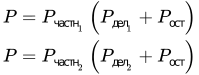
     \ begin {umped} P = P _ {\ text {private} _1} \ left (P _ {\ text {div} _1} + P _ {\ text {rest}} \ right) \\ P = P _ { \ text {private} _2} \ left (P _ {\ text {div} _2} + P _ {\ text {rest}} \ right) \ end {reuniu}

P1 P2 ( ). . , - P1 P2 , .


. . . . . , (2.3) :


  • P1 P2 ( π r ),


  • P1 P2 (),


  • π r P1 P2 (1,1,2 3,3,2),


  • P1 P2,


  • P (, -).


.


[1] Pshenichnikov S.B. Álgebra de texto. Researchgate Preprint, 2021


All Articles