Primeira impressão
O Forth ainda é conhecido, principalmente no desenvolvimento de sistemas embarcados, como algo como um extraordinário montador de alto nível, por exemplo, para microcontroladores - AmForth e Mecrisp . No entanto, uma vez ela era conhecida com uma aparência diferente - como uma linguagem de programação para aplicações científicas.

Fort foi escolhido como um meio pelo qual os detalhes da implementação de software de sistemas baseados em conhecimento são explicados pelos seguintes motivos: em primeiro lugar, um tradutor desta linguagem está disponível em quase todos os tipos de microcomputadores, em segundo lugar, é bastante barato, e , finalmente, tem muito em comum com as linguagens de inteligência artificial, em particular o Lisp.
Townsend K., Focht D. DESIGN E IMPLEMENTAÇÃO DE SOFTWARE DE SISTEMAS ESPECIALIZADOS EM COMPUTADORES PESSOAIS. Moscou: Finanças e Estatísticas, 1990.
Eu li isso e fiquei impressionado. Aqui estão três livros que conheço muito bem:

Linguagens de programação em livros, respectivamente - BASIC , Fortran e Fort! No livro de T. Toffoli:
CAM-6 , , , .
CAM-6 , IBM-PC (XT, AT ), , PC-DOS2. , , , , , , ( ) CRAY-1. CAM-6 FORTH IBM-PC 256 . .
CAM Forth. Forth , . , , CAM ( , , ).
! , ! , , 80- 90-. , , - , , , - , , ... , : C. Clay Marston and Gabriel G. BalintKurti. The Fourier grid Hamiltonian method for bound state eigenvalues and eigenfunctions // J. Chem. Phys. 91, 3571 (1989); doi: 10.1063/1.456888
1989 , - , , Matlab . - , .
, - HP 35s. - ( ). - .

, ( , ) , - .
see normcdf
: NORMCDF flit 1.41421 F/ ERF F1.0 F+ flit .500000 F* ;
ok
see erf
: ERF FDUP FSIGN FSWAP FDUP F* FDUP flit .147000 F*
FDUP flit 1.27324 F+ FSWAP F1.0 F+ F/ F*
FNEGATE FEXP FNEGATE F1.0 F+ FSQRT F* ;
ok
see fsign
: FSIGN F0< DUP INVERT - S>F ;
ok
see dup
DUP IS CODE ( $4012D8 53 )
push ebx
. - , . , . , , , , , - http://rigidus.ru/
, , . ? , , - . , , :(word) cvn { moveto show } def
{ moveto show } /S exch def
def () . Postscript, . : word moveto show ;
- , . ? . STATE=-1 (true ), , () STATE=0.
, . , , . - , . , . , . , , . :
Keep it simple
Do not speculate
Do it yourself
motherf*cker
, , - API. , - .
, - (, ) . , Intel 8087 - , ! :
: LNGAMMA ( x -- ln((x) )
\ Takes x > 0.0 and returns natural logarithm of (x).
FDUP 3.0E F+ 2.23931796330267E FSWAP F/
FOVER 2.0E F+ -27.0638924937115E FSWAP F/ F+
FOVER 1.0E F+ 41.4174045302371E FSWAP F/ F+
2.5066284643656E F+ FLN FSWAP
FDUP 4.15E F+ FLN
FOVER 0.50E F+ F*
FOVER 4.15E F+ F-
FROT F+ FSWAP FLN F- ;
, - - FDUP, FROT, FOVER
... , 4 . , . , .
- . , , . , : lngamma { f: x }
gforth. : lngamma {: f: x :}
VFX Forth. , , . - ?
, , . , :
variable apples ok
: +apples apples +! ; ok
: apples ." You have " apples @ . ." apples." cr ; ok
apples You have 0 apples.
ok
5 +apples ok
apples You have 5 apples.
ok
apples apples
, . , +apples
, . +apples
, . . , X. :
variable &x
: x &x @ ;
: (x) &x ! ;
: cube (x)
x x x * * ;
variable &x
: x &x @ ;
: (x) &x ! ;
: square (x)
x x * ;
3 square . 9 ok
3 cube . 27 ok
cube
square
. &x, x, (x) , , , . FORTH: .
F-PC Forth 3.60
FLOAD FFLOAT.SEQ
FLOAD EVAL.SEQ
: COMPARE ( c-addr1 u1 c-addr2 u2 -- n )
ROT
2DUP U< IF DROP COMPARE DUP 0= IF DROP 1 THEN EXIT THEN
2DUP U> IF NIP COMPARE DUP 0= IF DROP -1 THEN EXIT THEN
DROP COMPARE ;
: REFILL ( -- f ) \ CORE version for user input device and string only
loading @ IF ( file ) false EXIT THEN
'tib @ sp0 @ = IF ( user input device ) query true EXIT THEN
( EVALUATE ) false ;
MACRO: ++ PAD +PLACE ;
: (VARIABLE)
" VARIABLE &" PAD PLACE 2DUP ++
" : (" ++ 2DUP ++ " ) &" ++ 2DUP ++ " ! ;" ++
" : " ++ 2DUP ++ " &" ++ ( NAME ) ++ " @ ;" ++
PAD COUNT EVAL ;
: (FVARIABLE)
" FVARIABLE &" PAD PLACE 2DUP ++
" : (" ++ 2DUP ++ " ) &" ++ 2DUP ++ " F! ;" ++
" : " ++ 2DUP ++ " &" ++ ( NAME ) ++ " F@ ;" ++
PAD COUNT EVAL ;
: REFILL-AT-EOL? ( S: -- FLAG )
SOURCE NIP >IN @ > DUP 0= IF DROP REFILL THEN ;
: VARIABLES(
BEGIN BL WORD COUNT 2DUP " )" COMPARE
WHILE REFILL-AT-EOL?
WHILE (VARIABLE)
REPEAT
THEN 2DROP ;
: FVARIABLES(
BEGIN BL WORD COUNT 2DUP " )" COMPARE
WHILE REFILL-AT-EOL?
WHILE (FVARIABLE)
REPEAT
THEN 2DROP ;
:
\
VARIABLES( MAXIT )
FVARIABLES( ACCURACY UNLIKELY-VALUE )
\
-1.11E30 (UNLIKELY-VALUE)
1.0E-9 (ACCURACY)
50 (MAXIT)
\
MAXIT . 50 ok
, , , , . , x @ y @ + z !
x y + (z)
, @
f@
.
F-PC Forth
IBM PC AT, MS DOS , F-PC Forth. fpc36.zip, , dosbox. , .

IDE, , . IDE Borland .
F-PC Forth 3.60
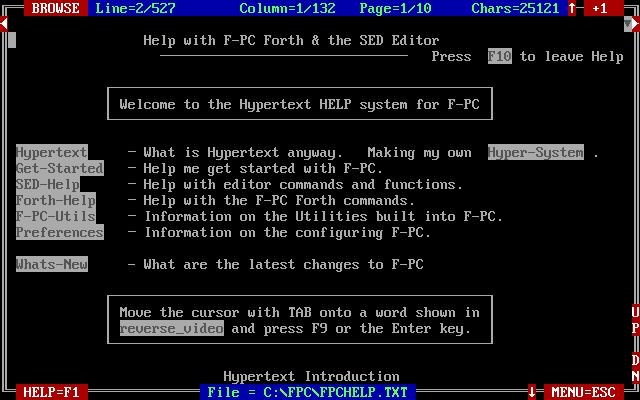
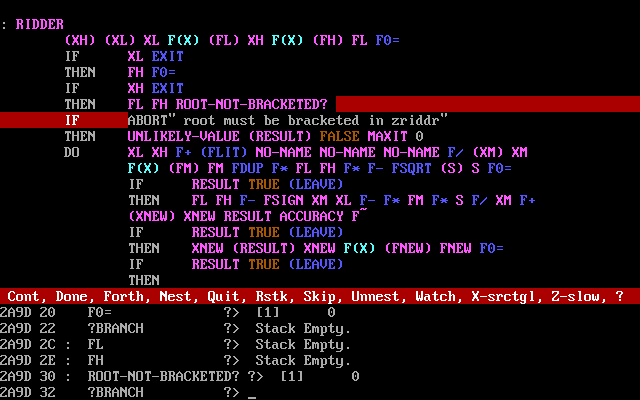

F-PC Forth 3.60
DEFER F(X)
VARIABLES( MAXIT )
FVARIABLES( XL XM XH XNEW FL FM FH FNEW S RESULT ACCURACY UNLIKELY-VALUE )
-1.11E30 (UNLIKELY-VALUE)
1.0E-9 (ACCURACY)
50 (MAXIT)
: FSIGN ( R1 -- R1 ) F0< DUP NOT - IFLOAT ;
: F~ ( R1 R2 R3 -- FLAG ) F-ROT F- FABS F> ;
: ROOT-NOT-BRACKETED? ( FL FH -- FLAG )
FDUP F0< FOVER F0> AND
( FB ) F0> ( FA ) F0< AND OR NOT ;
: RIDDER ( R1 R2 -- R1 ) (XH) (XL)
XL F(X) (FL) XH F(X) (FH)
FL F0= IF XL EXIT THEN
FH F0= IF XH EXIT THEN
FL FH ROOT-NOT-BRACKETED?
IF ABORT" ROOT MUST BE BRACKETED IN ZRIDDR" THEN
UNLIKELY-VALUE (RESULT) FALSE
MAXIT 0
DO
XL XH F+ 2.0E F/ (XM) XM F(X) (FM)
FM FDUP F* FL FH F* F- FSQRT (S)
S F0=
IF RESULT TRUE LEAVE THEN
FL FH F- FSIGN XM XL F- F* FM F* S F/ XM F+ (XNEW)
XNEW RESULT ACCURACY F~
IF RESULT TRUE LEAVE THEN
XNEW (RESULT) XNEW F(X) (FNEW)
FNEW F0=
IF RESULT TRUE LEAVE THEN
FNEW FSIGN FM F* FM F= NOT
IF XM (XL) FM (FL) RESULT (XH) FNEW (FH)
ELSE FNEW FSIGN FL F* FL F= NOT
IF RESULT (XH) FNEW (FH) THEN
FNEW FSIGN FH F* FH F= NOT
IF RESULT (XL) FNEW (FL) THEN
THEN
XL XH ACCURACY F~
IF RESULT TRUE LEAVE THEN
LOOP
IF RESULT DROP
ELSE ." ZRIDDR EXCEED MAXIMUM ITERATIONS" DROP THEN ;
: FUNC FDUP FEXP FSWAP -5.0E F* 3.0E F+ F+ ;
' FUNC IS F(X)
1.25E 1.6E RIDDER F.
, , : BASIC, Fortran 77, Pascal.
, ,
, . , , . .
\ Structures
: structure:
create ( structure name ) here 0 0 ,
does> @ ;
: +field
create ( field name ) over , +
does> @ + ;
: (cell) aligned 1 cells +field ;
: (float) faligned 1 floats +field ;
: end-structure ( addr size -- ) swap ! ;
, 1994. , F-PC , ANS Forth 94 , , win32forth, Gforth. , win32forth.
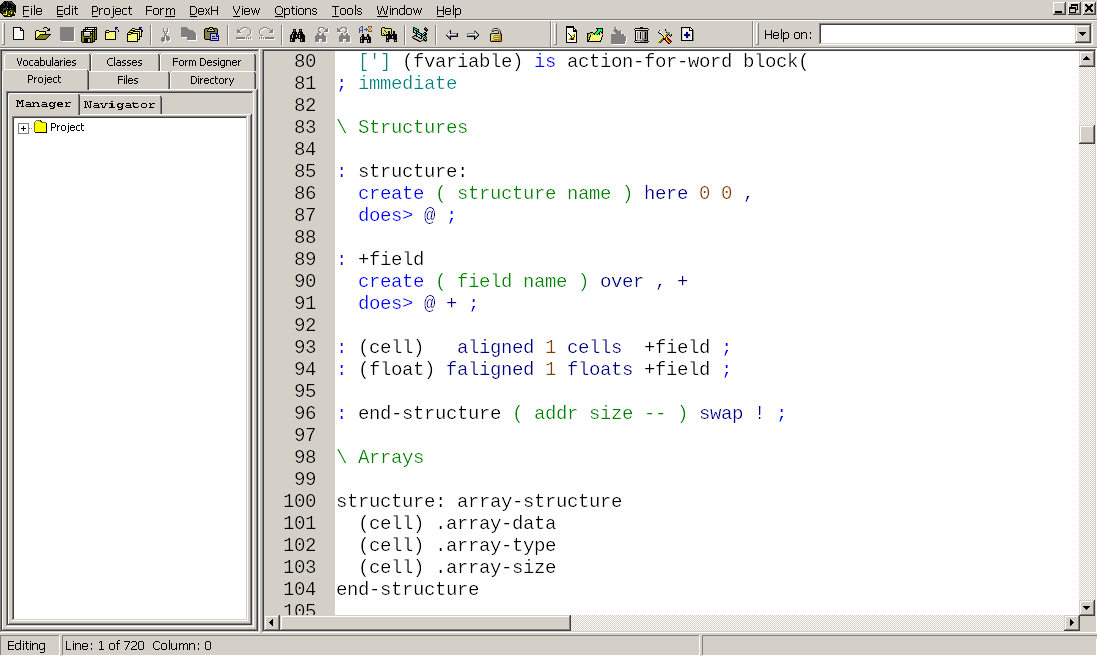
IDE , Windows ( wine ). , :
\ Arrays
structure: array-structure
(cell) .array-data
(cell) .array-type
(cell) .array-size
end-structure
: array: ( size -- )
create
0 here .array-data ! here .array-type ! here .array-size !
array-structure allot ;
: array-allocate ( vec -- )
>r r@ .array-size @ r@ .array-type @ * allocate throw r> .array-data ! ;
: array-free ( vec -- )
>r r@ .array-data @ free throw 0 r> .array-data ! ;
: array-element ( i vec -- *vec[i] )
>r r@ .array-type @ * r> .array-data @ + ;
, 3-5 . . .
code fs-array-element
pop eax
mov ebx, [ebx]
lea ebx, [ebx] [eax*8]
next c;
- The Forth Scientific Library Project, , . Do it yourself! , . . .
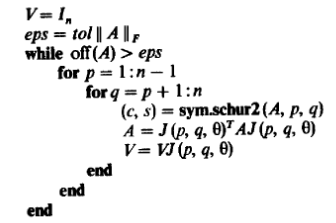
\ Cyclic Jacobi. Algorithm 8.5.3
\ Golub & Van Loan, Matrix Computations
fvariables( cos sin EPS )
variables( M EV MAXROT )
1.0e-10 (EPS)
50 (MAXROT)
: eig! (EV) (M)
EV matrix-set-identity!
MAXROT 0
do
M off-diagonal-norm EPS f<
if unloop exit then
M .matrix-rows @ 0
do M .matrix-cols @ i 1+
?do i j M sym.schur2 (sin) (cos)
cos sin i j M jacobi.rot'
cos sin i j M jacobi.rot
cos sin i j EV jacobi.rot
loop
loop
loop
." jacobi not converged" ;
, ? - , . eig
, , eig
.
, , C. Clay Marston and Gabriel G. BalintKurti. The Fourier grid Hamiltonian method for bound state eigenvalues and eigenfunctions // J. Chem. Phys. 91, 3571 (1989); doi: 10.1063/1.456888 , , . , .

:
Fourier grid Hamiltonian (FGH) :
\ Equation 26
fvariables( l d/N )
: sum (d/N)
1.0e (l)
0.0e ( N ) 1 rshift 0
do [ 2.0e fpi f* ] fliteral
l d/N f* f* fcos l f**2 f* f+
l 1.0e f+ (l)
loop ;
variables( diags n )
fvariables( dx 1/n )
: FGH! (diags) (dx)
diags .array-size @ (n)
n s>f 1/f (1/n)
[ -8.0e fpi f**2 f* ] fliteral
1/n fdup fdup f* f* f* dx f**2 1/f f*
n 0 do i s>f 1/n f* n sum fover f* i diags fa!
loop fdrop ;
boilerplate code , , , . . , ? python/numpy, Matlab Julia - .

Fort poderia substituir Fortran com bastante sucesso e o que mais havia naquela época. Não é tão difícil conviver com a notação pós-fixada, empilhar e lidar com um nível logo acima das instruções da máquina. Também é importante que o resultado do processo de trabalho em uma tarefa em Fort seja "não, bem, para o inferno, onde já foi feito, é mais fácil cancelar", ou um entendimento muito profundo de cada detalhe e essência do que está acontecendo.
Isso tudo é filosofia, é claro. No entanto, posso imaginar algum tipo de forte numérico até agora, em nosso tempo. Pode estar em algum lugar nas profundezas do equipamento de um astuto espectrômetro, detector ... Seria interessante saber onde.