Abaixo não há um tutorial, mas apenas uma folha de dicas para desenvolvedores já familiarizados com os conceitos básicos de C # .Net.
A folha de dicas contém apenas perguntas "básicas". Perguntas como "como você projetaria ...", "quais camadas de aplicativo ..." não estão incluídas na folha de dicas. Conforme observado nos comentários, as perguntas são mais prováveis para junho, no entanto, elas são feitas em entrevistas intermediárias.
Formatação de código
Nos exemplos, para resumir, o parêntese de abertura {não está em uma nova linha. O entrevistador pode estar confuso porque em C #, é comum colocar {em uma nova linha. Portanto, é melhor usar uma formatação comum durante a entrevista.
pilha e pilha, tipo de valor e tipo de referência
tipo de referência (classe de exemplo, interface) são armazenados em um grande heap
tipo de valor (exemplo int, struct, referências a instâncias do tipo de referência) são armazenados na pilha rápida
ao atribuir (passar para um método) os tipos de valor são copiados, os tipos de referência são passados por referência (consulte a seção de estrutura abaixo)
estrutura
tipo de valor => quando atribuído (passado ao método) todos os campos e propriedades são copiados, não pode ser nulo
sem herança
suporta interfaces
se houver um construtor, todos os campos e propriedades devem ser definidos nele
interface IMyInterface {
int Property { get; set; }
}
struct MyStruc : IMyInterface {
public int Field;
public int Property { get; set; }
}
class Program {
static void Main(string[] args) {
var ms = new MyStruc {
Field = 1,
Property = 2
};
// value type ,
//
TryChange(ms);
Console.WriteLine(ms.Property);
// ==> ms.Property = 2;
// boxing ( )
IMyInterface msInterface = new MyStruc {
Field = 1,
Property = 2
};
// object (reference type)
// , msInterface
TryChange(msInterface);
Console.WriteLine(msInterface.Property);
// ==> ms.Property = 3;
}
static void TryChange(IMyInterface myStruc) {
myStruc.Property = 3;
}
}
DateTime é uma estrutura, portanto, não faz sentido verificar campos do tipo DateTime para nulos:
class MyClass {
public DateTime Date { get; set; }
}
var mc = new MyClass();
// false,
// .. DateTime struct (value type) null
var isDate = mc.Date == null;
boxing / unboxing
// boxing (value type, stack -> object, heap)
int i = 123;
object o = i;
// unboxing (object, heap -> value type, stack)
object o = 123;
var i = (int)o;
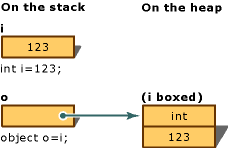
// boxing
int i = 123;
object o = i;
i = 456;
// ==> .. i, o
// i = 456
// o = 123
// boxing
IMyInterface myInterface = new MyStruct(2);
// boxing i
int i = 2;
string s = "str" + i;
// .. String.Concat(object? arg0, object? arg1)
// unboxing, .. Session Dictionary<string, object>
int i = (int)Session["key"];
string
heap reference type
( ) value type
string a = "hello";
string b = "hello";
// string value type
// ( == )
Console.WriteLine(a == b);
// ==> true
var mc1 = new MyClass { Property = 1 };
var mc2 = new MyClass { Property = 2 };
// reference type
// heap
Console.WriteLine(mc1 == mc2);
// ==> false
const vs readonly
const - =>
readonly -
class MyClass {
public const string Const = "some1";
public readonly string Field = "some2";
}
var cl = new MyClass();
Console.WriteLine(MyClass.Const);
Console.WriteLine(cl.Field);
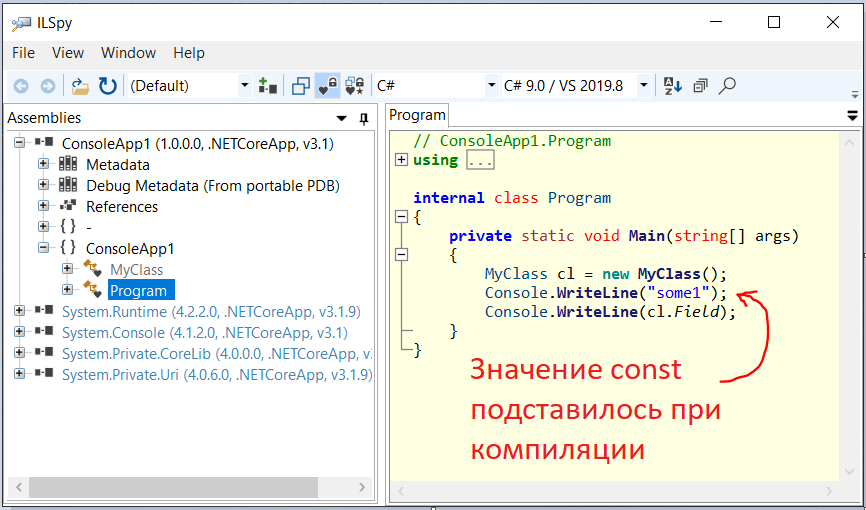
- dll , :
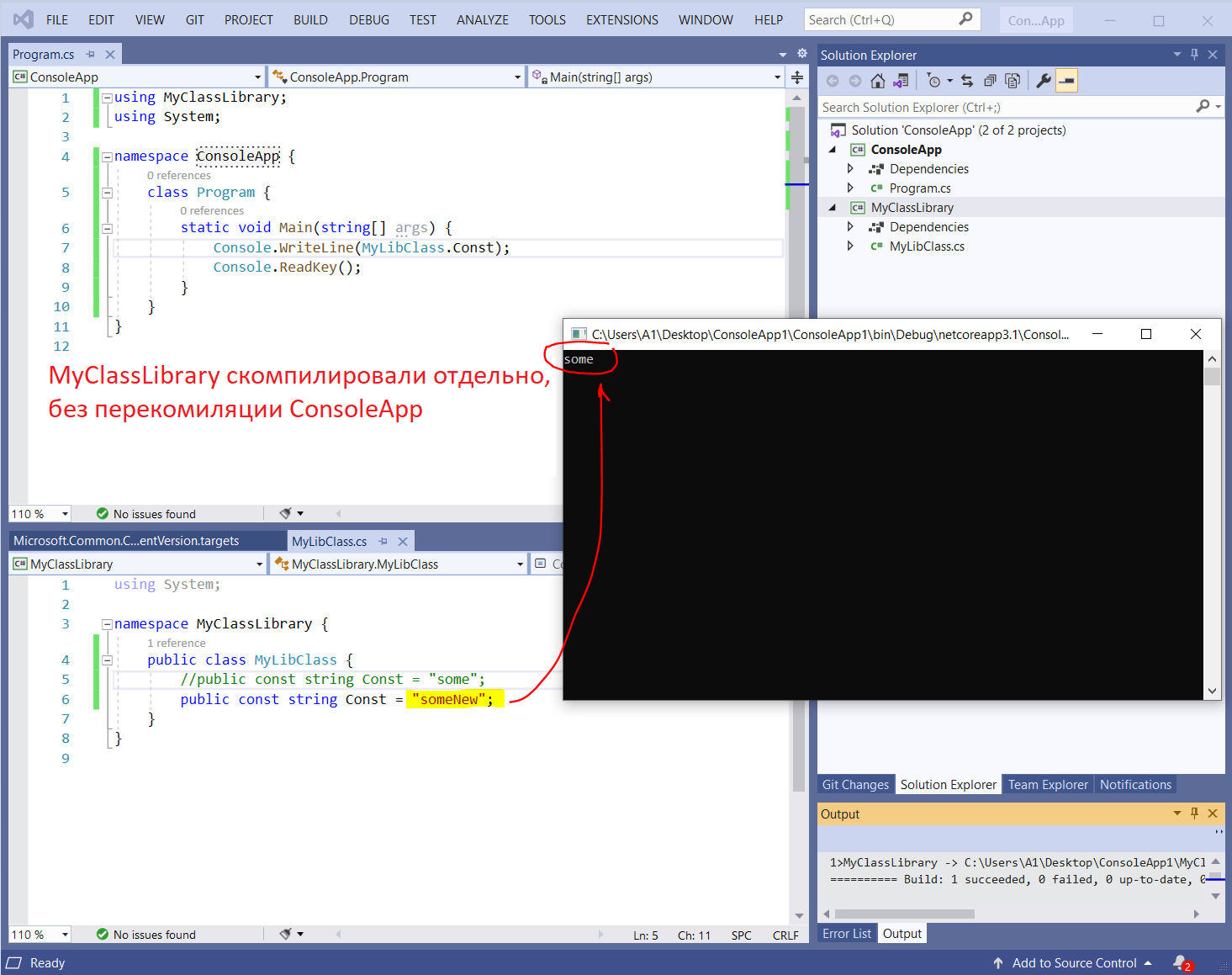
ref out
ref out new class struct
out ref, ,
struct MyStruc {
public int Field;
}
class Program {
static void Main(string[] args) {
var ms = new MyStruc { Field = 1 };
createNew(ms);
Console.WriteLine(ms.Field);
// ==> ms.Field = 1
var ms2 = new MyStruc { Field = 1 };
createNew2(ref ms2);
Console.WriteLine(ms2.Field);
// ==> ms2.Field = 2
}
static void createNew(MyStruc myStruc) {
myStruc = new MyStruc { Field = 2 };
}
static void createNew2(ref MyStruc myStruc) {
myStruc = new MyStruc { Field = 2 };
}
static void createNew3(out MyStruc myStruc) {
// ,
// myStruc = new
}
}
generic-.
interface IAnimal { }
class Cat : IAnimal {
public void Meow() { }
}
class Dog : IAnimal {
public void Woof() { }
}
// , List -
// , List Add,
// ( . )
List<IAnimal> animals = new List<Cat>();
// , IEnumerable -
// IEnumerable
IEnumerable<IAnimal> lst = new List<Cat>();
Add List:
//
List<Cat> cats = new List<Cat>();
cats.Add(new Cat());
List<Cat> animals = cats;
animals.Add(new Cat());
foreach (var cat in cats) {
cat.Meow(); // cats 2
}
//
List<Cat> cats = new List<Cat>();
cats.Add(new Cat());
List<IAnimal> animals = cats;
animals.Add(new Dog()); // , :
//
foreach (var cat in cats) {
cat.Meow(); // cats 1 1 , Meow()
}
Object
ToString
GetType
Equals
GetHashCode
ToString GetType .
Equals GetHashCode , linq, . , .. .Net. hash .
GetHashCode .
,
class MyClass {
public event Action<string> Evt;
public void FireEvt() {
if (Evt != null)
Evt("hello");
// Evt("hello") -
//
//foreach (var ev in Evt.GetInvocationList())
// ev.DynamicInvoke("hello");
}
public void ClearEvt() {
// MyClass
Evt = null;
}
}
var cl = new MyClass();
//
cl.Evt += (msg) => Console.WriteLine($"1 {msg}");
cl.Evt += (msg) => Console.WriteLine($"2 {msg}");
//
Action<string> handler = (msg) => Console.WriteLine($"3 {msg}");
cl.Evt += handler;
cl.Evt -= handler;
cl.FireEvt();
// ==>
// 1 hello
// 2 hello
//
// "+=" "-="
// MyClass
cl.Evt = null;
Finalizer (destructor) ~
garbage collector
.Net,
struct
finalizer: IDisposable. Dispose finalizer, Dispose. finalizer .
throw vs "throw ex"
try {
...
} catch (Exception ex) {
// , .. CallStack
throw;
// CallStack
throw ex;
}
Garbage collector
. heap , , . Garbage collector. :
( ) -
heap
(Generation 0) - , . Generation 0.
- Generation 1.
Generation 0 , . - Generation 1.
, 2 - Generation 2.
Derived.Static.Fields
Derived.Static.Constructor
Derived.Instance.Fields
Base.Static.Fields
Base.Static.Constructor
Base.Instance.Fields
Base.Instance.Constructor
Derived.Instance.Constructor
class Parent {
public Parent() {
// virtual
//
//
DoSomething();
}
protected virtual void DoSomething() {
}
}
class Child : Parent {
private string foo;
public Child() {
foo = "HELLO";
}
protected override void DoSomething() {
Console.WriteLine(foo.ToLower()); //NullReferenceException
}
}
( , ), . (, , ) - . vs vs .
-
-
- , , )
-
SOLID
Single responsibility - , , God-object
Open closed principle -
Liskov substitution -
Interface segregation principle -
Dependency inversion principle - , ,
3
(: )
(: )
(: )
IDisposable, try, catch, finally
singleton ( lock)
(mutex, semaphore ..)
/ . : . , . . ? ( )?
SQL , HAVING
Stack and heap – .NET data structures
Boxing and Unboxing (C# Programming Guide)
Tipos de referência integrados (referência C #)
Covariância e contravariância em genéricos
Problema de variância C #: atribuindo lista como lista
Finalizadores (guia de programação C #)
Destruidores em aplicações do mundo real?
Chamada de membro virtual em um construtor
Herança vs. Composição vs. Agregação