Continuamos a série de artigos sobre a construção de sistemas de roteamento com requisitos complexos baseados no banco de dados Open Source PostgreSQL e na extensão PgRouting no OpenStreetMap. Hoje falaremos sobre como adicionar suporte para estradas de mão única (direções de condução). Freqüentemente, a falta desse suporte é o principal motivo para mudar o PgRouting para um "mecanismo" de roteamento diferente. Como de costume, todos os dados e resultados estão disponíveis em meu repositório OSM Routing Tricks no GitHub , que adiciono à medida que publico.
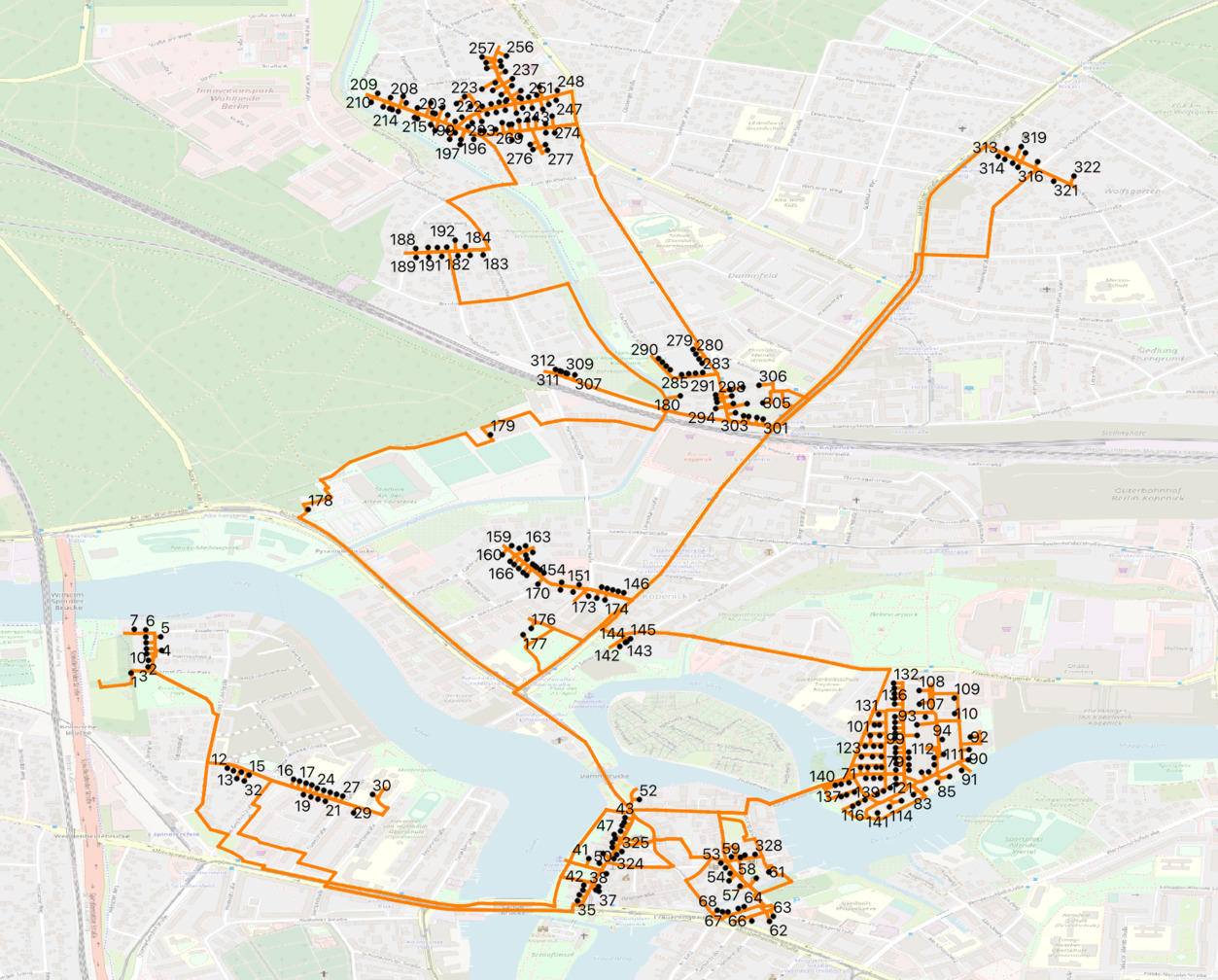
Rota pequena de 330 endereços no OpenStreetMap.
O que são estradas de mão única e por que são necessárias
, , , . , . , , .
, , . , , — , .. , (, ) , ( , ), .
, — , ( , , ) , ( , — , PgRouting , ). , , .
PgRouting
PgRouting pgr_TSP — Using Simulated Annealing approximation algorithm :
If using directed := true, the resulting non symmetric matrix must be converted to symmetric by fixing the non symmetric values according to your application needs.
, , . , . , , Travelling salesman problem: Asymmetric:
Solving an asymmetric TSP graph can be somewhat complex. The following is a 3×3 matrix containing all possible path weights between the nodes A, B and C. One option is to turn an asymmetric matrix of size N into a symmetric matrix of size 2N.
, , ( ) . , PgRouting, , . . — , . . , ( , ).
:
| A | B | C | |
|---|---|---|---|
| A | 1 | 2 | |
| B | 6 | 3 | |
| C | 5 | 4 |
:
| A | B | C | A' | B' | C' | |
|---|---|---|---|---|---|---|
| A | -w | 6 | 5 | |||
| B | 1 | -w | 4 | |||
| C | 2 | 3 | -w | |||
| A' | -w | 1 | 2 | |||
| B' | 6 | -w | 3 | |||
| C' | 5 | 4 | -w |
-w , ,
w=0 is not always low enough
- PgRouting. PgRouting , ( ) [] , PgRouting ( , , ).
CREATE OR REPLACE FUNCTION pgr_dijkstraSymmetrizeCostMatrix(matrix_cell_sql text,
    OUT start_vid BIGINT, OUT end_vid BIGINT, OUT agg_cost float)
RETURNS SETOF RECORD AS
$BODY$
DECLARE
    sql text;
    r record;
BEGIN
    sql := 'with edges as (' || matrix_cell_sql || ')
        select 3e9+start_vid as start_vid, end_vid as end_vid, agg_cost from edges
        union
        select end_vid, 3e9+start_vid, agg_cost from edges
        union
        select 3e9+start_vid, start_vid, 0 from edges
        union
        select start_vid, 3e9+start_vid, 0 from edges
        union
        select start_vid, end_vid, 1e6 from edges
        union
        select 3e9+start_vid, 3e9+end_vid, 1e6 from edges
        ';
    FOR r IN EXECUTE sql LOOP
        start_vid := r.start_vid;
        end_vid   := r.end_vid;
        agg_cost  := r.agg_cost;
        RETURN NEXT;
    END LOOP;
END;
$BODY$
LANGUAGE plpgsql VOLATILE STRICT;
, . , PgRouting , ,
An Infinity value was found on the Matrix
- ( pgr_dijkstraSymmetrizeCostMatrix() , , , , ):
CREATE OR REPLACE FUNCTION pgr_dijkstraValidateCostMatrix(matrix_cell_sql text,
    OUT start_vid BIGINT, OUT end_vid BIGINT, OUT agg_cost float)
RETURNS SETOF RECORD AS
$BODY$
DECLARE
    sql text;
    r record;
BEGIN
    sql := 'WITH RECURSIVE src AS (' || matrix_cell_sql || '),
    dst AS (
        select
            *
        from src where start_vid =
            (select
                start_vid
            from src
            group by start_vid
            order by count(*) desc
            limit 1)
        union
        select
            src.*
        from src, dst
        where src.start_vid=dst.end_vid
    )
    select * from dst';
    FOR r IN EXECUTE sql LOOP
        start_vid := r.start_vid;
        end_vid   := r.end_vid;
        agg_cost  := r.agg_cost;
        RETURN NEXT;
    END LOOP;
END;
$BODY$
LANGUAGE plpgsql VOLATILE STRICT;
PgRouting . , , , ( ).
, . load.sh PostgreSQL .
, , . , , . , ( ) . , (type='osm') (type='osmreverse') . , ( , , ). , (type='osm') — (type='osmreverse'). , :
    case when (type='osmreverse' and oneway) then 1000000 else length end as cost,
    case when type ilike 'osm%' then 1000000 else length end as reverse_cost,
length — . ( ), .
330 PgRouting pgr_TSP() pgr_dijkstraSymmetrizeCostMatrix() pgr_dijkstraValidateCostMatrix(). directed=true, pgr_TSP() (, , ). , SQL route.sql "route" , QGIS. QGIS , . route.qgs .
( ):

, , , . OpenStreetMap, :

OpenStreetMap, 329,330,331 :
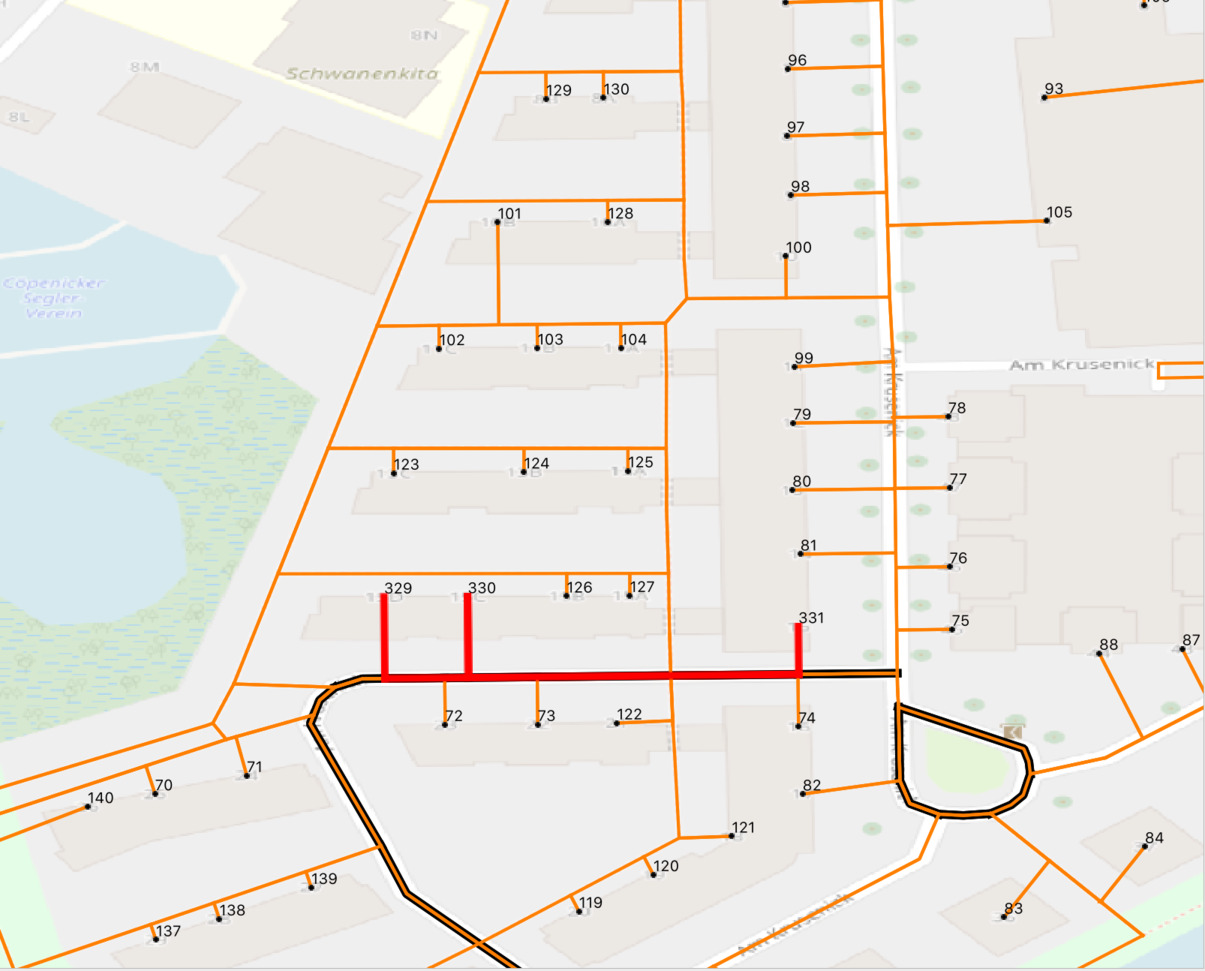
( ) 72,73,74 ( ):
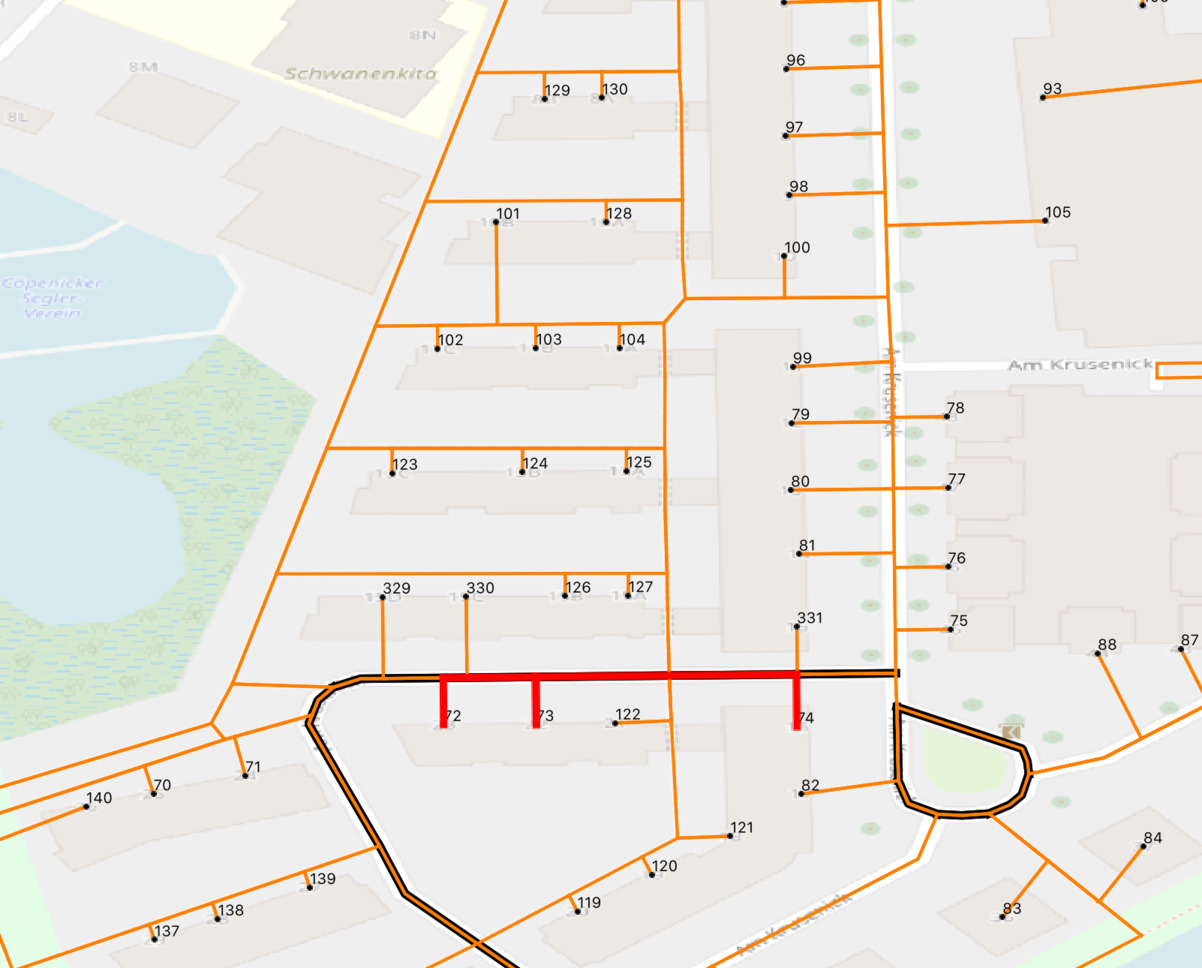
. (. ). , , pgr_TSP().
, , - . - .
PgRouting, . , , .
, , , pgr_TSP(). , — , PgRouting " " . , , , .
É possível obter um resultado semelhante com numeração sequencial de edifícios entre cruzamentos de forma diferente, sem aumentar a matriz de peso com uma correspondente desaceleração na construção do percurso? Sim você pode. Além disso, você também pode acelerar significativamente a construção da rota (por exemplo, por uma ou duas ordens decimais), inclusive levando em consideração estradas de mão única. Falaremos sobre isso na próxima vez.